October 2026 Tax News

Welcome to our October 2026 tax news!

Our monthly newsletter covers a range of tax related topics as well as celebrating what we’re doing as a company.

Topics covered this month includes:

  • Cryptoassets: Why investors must declare income and gains to HMRC

  • When is VAT on cars reclaimable?

  • MTD for income tax: The story continues in 2027

  • And much more!

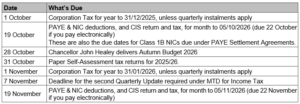
You’ll also find useful dates for your diary this October and November.

Please contact us if you have any questions regarding any of the articles or if you would like further information on a topic we haven’t covered.

October 2026 Tax News

Cryptoassets: Why investors must declare income and gains to HMRC

Cryptoassets have moved into the financial mainstream, with many individuals now holding Bitcoin, Ethereum and other digital assets alongside traditional investments. However, a common misconception is that crypto transactions are anonymous or outside the scope of UK taxation. They are not.

HMRC expects taxpayers to declare taxable crypto income and gains, and failure to do so can lead to interest, penalties and, in serious cases, investigations. HMRC have published extensive guidance on the taxation of cryptoassets and receives increasing amounts of information from exchanges and other sources. Starting from the 2026 calendar year, HMRC will receive tax-relevant information on UK-based individuals who have used UK cryptoasset service providers.

How crypto is taxed in the UK

The UK does not have a separate crypto tax regime. Instead, existing tax rules are applied depending on the nature of the transaction.

For most private investors, profits are taxed under the Capital Gains Tax (CGT) rules. A taxable disposal can occur when you:

  • Sell crypto for cash.
  • Exchange one cryptoasset for another.
  • Use crypto to buy goods or services.
  • Gift crypto to someone other than a spouse or civil partner.

Many people are surprised to learn that swapping Bitcoin for Ethereum is a taxable event, even if no cash is received.

Some crypto receipts may instead be subject to Income Tax – for example, rewards from mining and staking. For most, this will be taxed as miscellaneous, not trading income.

Why disclousure matters 

Crypto transactions often generate a large number of taxable events, making record-keeping essential. Investors should retain details of purchases, disposals, transfers, fees and wallet addresses.

Importantly, moving crypto between wallets that you beneficially own is generally not a disposal for tax purposes. However, most other transactions may have tax consequences.

With HMRC increasing its focus on crypto compliance, you should review your holdings regularly and ensure that all taxable income and gains are reported correctly on your tax returns. Seeking advice early can help avoid costly mistakes and provide peace of mind that your crypto tax affairs are fully compliant. Where an error in a return is discovered, a voluntary disclosure will often produce a better outcome than waiting for HMRC to make contact, so do contact us if you have any concerns.


When is VAT on cars reclaimable?

A business can normally only reclaim VAT on the purchase of a car if the car is not available for any private use whatsoever. This is a very strict test. Typically, the business must be able to demonstrate that private use is prohibited and impossible in practice.

Examples where VAT recovery may be allowed are set out in HMRC guidance and The Value Added Tax (Input Tax) Order 1992 and include:

  • A car used exclusively as a taxi.
  • A driving school vehicle with dual controls.
  • A car acquired solely for resale by a motor dealer.
  • A car held for short-term hire.
  • A company car kept permanently on business premises and not available for private use.

In most owner-managed businesses, VAT on the purchase of a company car cannot be reclaimed because the vehicle is available for private use, even if actual private use is minimal.

By contrast, VAT on vans is generally recoverable, subject to the normal input tax rules. VAT on running costs of a car, such as repairs and servicing, is usually recoverable to the extent they relate to the business.

In a recent case, Luxurico Ltd v HMRC [2026] TC10001, the First Tier Tribunal (FTT) found that input VAT was recoverable on a luxury vehicle hire business’s acquisition of a hypercar (an ultra-exclusive, ultra-high-performance sports car). The taxpayer’s intention at the time of purchase, and not necessarily subsequent use, was key in determining allowability.

Luxurico argued that at the time they purchased the supercar, they intended to use it as a private-hire vehicle. HMRC sought to deny the VAT reclaim on the basis that there was little evidence that the car was subsequently used for its intended purpose.

The FTT’s focus was on Luxurico’s intention at the time the VAT was incurred – HMRC’s reliance on the vehicle’s subsequent use missed the point. A number of factors had resulted in reduced hiring of the vehicle, but the FTT found that at the time of acquisition, Luxurico intended primarily to use the vehicle for a relevant purpose.

The appeal was allowed, meaning Luxurico was able to reclaim the VAT incurred on the supercar.

VAT on cars remains difficult to recover, but this case demonstrates that it is not always impossible. Contact us if you have, or are contemplating, the purchase of a car for business purposes and we can advise on the options for VAT recovery.

MTD for income tax: The story continues in 2027

Certain landlords and self-employed individuals should start preparing now for the next phase of Making Tax Digital (MTD) for Income Tax. Taxpayers with qualifying income above £30,000 in the 2025/26 tax year will be required to join MTD from 6 April 2027. Qualifying income includes gross income from property lettings and self-employment before expenses are deducted.

MTD represents the biggest change to the Self Assessment system for many years. Instead of keeping paper records and submitting information annually, affected taxpayers will need to maintain digital records using compatible software and send quarterly updates of their income and expenses to HMRC. At the end of the tax year, a final digital submission will be required to confirm their tax position.

Landlords and traders with income above the threshold should review their bookkeeping processes now and speak to us about suitable software. Early preparation will make the transition much smoother and help avoid compliance issues when MTD becomes mandatory in April 2027.

Additional self assessment disclosures for directors in 2025/26

Additional reporting requirements for directors of close companies came into force for Self Assessment returns from 2025/26 onwards. A close company is generally a company that is controlled by five or fewer shareholders or by its directors. The new requirements mean directors of close companies must report the following on their tax return:

  • The name of the close company.
  • The registered number of the close company.
  • The amount of income they receive from dividends from that company in that tax year.
  • The highest percentage of their shareholding.

The Self Assessment return already included boxes to indicate whether a taxpayer was a director of a close company, but completing these boxes was optional. The new rules mean directors of close companies are now obligated to complete the boxes.

Only directors who currently need to complete a Self Assessment return need to report close company information.

If the company is only a close company for part of the tax year, the new boxes must still be completed.

HMRC have recently confirmed the following:

  • Where directors are unpaid and/or have zero shareholdings in the close company, they must still complete the new boxes on the tax return. Listing unpaid directorships in the additional information box is not an acceptable option.
  • Directors of dormant close companies must also complete the new boxes.
  • Directors of registered charities or Community Interest Companies do not need to complete the new boxes where they did not receive, or become entitled to receive, any employment income or dividend income.

A £60 penalty may apply for the incorrect completion of the close company boxes. It is therefore important that you advise us of any directorships that you held in a tax year.

Supporting The Tom Youngs Foundation for 2026!

Our fundraising journey at Gascoynes originally started in support of Tom Youngs, one of our Managing Director’s Chris’ close friends who had been diagnosed with Multiple Sclerosis (MS) at the time. Sadly, Tom passed away in May last year after also being diagnosed with cancer.  

So far, we’ve hosted two coffee mornings – one at our Bury St Edmunds office and one at our Diss office. We’re delighted to share that, between both offices, we’ve raised nearly £300.

We have also held a Charity Golf Day, and what a fantastic day it was! Thanks to the generosity of our players and everyone who contributed, the event raised over £1250.

On 13th August, we held our Ipswich Coffee Morning. Thanks to everyone who attended, donated and baked, we raised £443.75.

Thank you to everyone who has supported our fundraising efforts so far – every contribution makes a difference!

Find out more here:

https://gascoynes.co.uk/supporting-the-tom-youngs-foundation-for-2026/ 

Key tax dates for October and November

Contact us

If you have any queries on the topics discussed in this newsletter, or any other accounting needs, please do not hesitate to email your client manager, or call the office today on:

  • 01284 755956 for Bury St Edmunds Office.
  • 01953 438450 for Wymondham Office.
  • 01473 212717 for Ipswich Office.
  • 01379 641690 for Diss Office.
  • 01449 516506 for Stowmarket Office.

We look forward to speaking with you soon!