August 2026 Tax News

Welcome to our August 2026 tax news!

Our monthly newsletter covers a range of tax related topics as well as celebrating what we’re doing as a company.

Topics covered this month includes:

  • HMRC’s 2026 Tax update
  • Further digital compliance and anti-fraud measures
  • HMRC targets side hustle income
  • And much more!

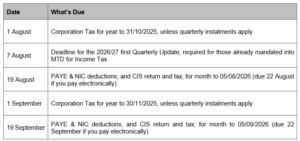
You’ll also find useful dates for your diary this  August and September.

Please contact us if you have any questions regarding any of the articles or if you would like further information on a topic we haven’t covered.

August 2026 Tax News

Questions over future tax changes under new Prime Minister Andy Burnham 

Since becoming Prime Minister, Andy Burnham has made cost-of-living support a key focus. One headline measure announced this month is the planned removal of VAT on household electricity from October 2026, which the Government estimates could reduce average household bills by around £45 a year. Household electricity is currently subject to VAT at 5%.

At the same time, attention is turning towards how future tax policy might develop. Economists and commentators are already speculating about whether further tax reform could feature in the Autumn Budget.

For business owners, landlords and investors, the key message is not to react to headlines. Many of the most talked-about measures remain informal proposals or speculation, rather than law. Changes to capital gains tax, property taxation and other wealth-related taxes have all been widely discussed, but little has been formally confirmed at this stage.

History shows that major tax changes are often signalled well before implementation. That means now is a good time to review long-term plans, particularly if you are considering property sales, business disposals or succession planning.

Our recommended approach:

  • Avoid making rushed decisions based on speculation.
  • Review your current tax position.
  • Consider scenario planning ahead of the Autumn Budget.
  • Seek advice before implementing major transactions.

The coming months are likely to bring further tax announcements, making regular reviews of your business and personal plans more important than ever. If you’d like to discuss any of the above issues, please get in touch with us – we’d be happy to help.

HMRC’s 2026 tax update 

Prior to Andy Burnham’s appointment as Prime Minister and the appointment of John Healey as Chancellor, HMRC published a raft of consultations and policy announcements on 23 June 2026.

The wide-ranging package of consultations and policy announcements was aimed at making the tax system simpler, more digital and, in HMRC’s words, fairer. While many of the proposals are still at consultation stage, they give us an indication of the government’s direction of travel over the next few years.

Accelerated, more frequent, tax payments

Perhaps the most significant proposal is a consultation on “Timely Payments” for Self Assessment taxpayers.

The government is exploring ways to collect more tax during the year rather than relying on large payments due each January and July. For taxpayers who have both PAYE income and Self Assessment income, the proposal could require more of their tax liability to be collected through PAYE from April 2029.

HMRC is also considering wider reforms to the Payments on Account regime for other Self Assessment taxpayers. These reforms would require taxpayers to pay all of their forecast tax liability during the tax year, with a balancing payment/repayment being due when their tax position is finalised on the 31 January following the end of the tax year.


For many sole traders and landlords, spreading payments throughout the year could help with budgeting and reduce the shock of large tax bills. However, it may also accelerate when tax is paid, affecting cash flow planning.

HMRC’s 2026 tax update 

Review of Benchmark scale rates

Employers should note that HMRC is reviewing its Benchmark Scale Rates (BSRs) and Overseas Scale Rates (OSRs).

These are the flat-rate allowances businesses can use to reimburse employees for meals, accommodation and travel expenses without checking every receipt. The government says the review will consider whether current rates still reflect actual costs and whether the system can be simplified.

For growing businesses with travelling staff, any simplification could reduce administrative work and improve consistency in expense claims.

Electronic invoicing 

HMRC’s Tax Update included an important announcement about the future of electronic invoicing (e-invoicing) in the UK. The government confirmed that the ‘Peppol’ framework will be the core network used to support the UK’s planned e-invoicing system.

Electronic invoicing is not simply emailing a PDF invoice. Instead, invoices are created in a standard digital format and sent directly between accounting systems. This reduces manual data entry, improves accuracy and can speed up payment processing. Peppol is an international framework that enables different accounting and finance systems to exchange invoice data securely and consistently.

The government is working towards a mandatory e-invoicing regime from 2029, primarily covering VAT invoices for business-to-business and business-to-government transactions. HMRC has confirmed that businesses will exchange invoices through software providers rather than through a central government platform.

For small businesses, now is not the time to panic. However, it is a good opportunity to review bookkeeping and invoicing systems. Businesses already using modern cloud accounting software are likely to find the transition easier than those relying on manual processes.

The full implementation roadmap is expected later in 2026.

HMRC’s 2026 tax update 

Proposed change to the CGT holdover relief calculation

The government has published draft legislation to correct an anomaly in the Capital Gains Tax (CGT) holdover relief rules for gifts of business assets, which allow a capital gain on a gift to be deferred until the recipient disposes of the asset. The proposed change would amend the formula used to calculate relief on certain share transfers, helping ensure the relief operates as intended.

The measure is not yet law, but it could improve the tax position for some business owners transferring shares as part of succession planning, family ownership arrangements or business restructures.

If you are considering a transaction that may be affected, it may be worth discussing whether it can be delayed until the legislation is enacted. Waiting could result in a more favourable outcome, although professional advice should be sought before making any decisions.

Modernising how company payments to shareholders are taxed

The government has also launched a consultation on modernising the rules that determine how some payments from companies to shareholders are taxed.

Many of these rules date back decades and have become increasingly complex. The review covers areas such as distributions, returns of capital, company reorganisations and interactions with the loans to participators rules.

For owner-managed businesses, this is unlikely to lead to immediate changes, but it signals potential reform of an area that affects dividends, company restructures and extraction of profits.

HMRC’s 2026 tax update 

Further digital compliance and anti-fraud measures

Several consultations focus on tackling tax evasion and improving compliance.

These include proposals to extend VAT liability rules for online marketplaces, introduce software standards to combat electronic sales suppression systems, and create a new offence for making reckless untrue statements in direct tax matters.

For compliant businesses, these measures are largely aimed at creating a level playing field by targeting those who deliberately understate sales or avoid tax obligations.

What happens next?

Most of the measures announced on 23 June are consultations rather than immediate law changes. However, they provide an early warning of where tax administration is heading:

  • Greater use of digital systems.
  • More real-time tax reporting and payment.
  • Increased focus on compliance and data.
  • Simplification of some long-standing tax rules.

For now, the best approach is to keep good records, maintain robust bookkeeping systems and monitor consultations that could affect your business. Many of today’s consultations have the potential to become tomorrow’s tax rules.

To read the Tax Update, see here.

HMRC targets side hustle income

HMRC has launched a fresh summer campaign reminding people with “side hustles” that extra income may need to be reported for tax purposes. The announcement specifically highlights people earning income from wedding services, online selling, content creation, freelancing and similar activities.

The key figure remains the £1,000 trading allowance. If total income from side activities exceeds £1,000 during the tax year, there may be an obligation to register for Self Assessment and declare the income to HMRC.

This is particularly relevant because HMRC now receives increasing amounts of information from digital platforms. Data from marketplaces and gig economy platforms can be matched against tax returns, making it easier for HMRC to identify undeclared income.

Importantly, not everyone selling online has a tax problem. Selling unwanted personal possessions is generally not taxable. However, regularly buying or making goods to sell, or providing services for payment, is likely to be treated as trading.

If you have a side hustle, you should:

  • Review any additional income streams.
  • Check whether total trading income exceeds £1,000.
  • Register for Self Assessment if required.
  • Keep proper records from the outset rather than trying to reconstruct them later.

Early disclosure is almost always easier and cheaper than dealing with an HMRC enquiry.

Supporting The Tom Youngs Foundation for 2026!

Our fundraising journey at Gascoynes originally started in support of Tom Youngs, one of our Managing Director’s Chris’ close friends who had been diagnosed with Multiple Sclerosis (MS) at the time. Sadly, Tom passed away in May last year after also being diagnosed with cancer. 

So far, we’ve hosted two coffee mornings – one at our Bury St Edmunds office and one at our Diss office. We’re delighted to share that, between both offices, we’ve raised nearly £300.

Last month, we also held our Charity Golf Day, and what a fantastic day it was! Thanks to the generosity of our players and everyone who contributed, the event raised over £1250.

Next up is our Ipswich Coffee Morning on 13th August. Everyone is welcome, and we’d love to see you there! If you’re interested in joining us or would like to find out more, head over to our social media channels for all the details.

Thank you to everyone who has supported our fundraising efforts so far – every contribution makes a difference!

Find out more here:

https://gascoynes.co.uk/supporting-the-tom-youngs-foundation-for-2026/

Key tax dates for August and September


Contact us

If you have any queries on the topics discussed in this newsletter, or any other accounting needs, please do not hesitate to email your client manager, or call the office today on:

  • 01284 755956 for Bury St Edmunds Office.
  • 01953 438450 for Wymondham Office.
  • 01473 212717 for Ipswich Office.
  • 01379 641690 for Diss Office.
  • 01449 516506 for Stowmarket Office.

We look forward to speaking with you soon!