June 2026 Tax News

Welcome to our June 2026 tax news!

Our monthly newsletter covers a range of tax related topics as well as celebrating what we’re doing as a company.

Topics covered this month includes:

  • Great British summer savings
  • Dividends on the 2025/26 Self Assessment Tax Return
  • Employment status of professional football match officials
  • And much more!

You’ll also find useful dates for your diary this June and July.

Please contact us if you have any questions regarding any of the articles or if you would like further information on a topic we haven’t covered.

June 2026 Tax News

Great British summer savings 

On 21 May 2026, the Chancellor, Rachel Reeves MP, announced ‘Great British Summer Savings’, a package of measures aimed at cutting costs for families, particularly those with children.

The following two measures are of particular importance to businesses:

Tax-free mileage rates

A 10p per mile increase in tax‑free mileage rates will apply in the 2026/27 tax year, backdated to April 2026. The increase relates to the amount per business mile driven that attracts tax relief and affects both employees and the self-employed. HMRC’s mileage rates guidance has been updated as follows:

For the self-employed:

For employees:

Note that only the rate for cars and vans for the first 10,000 miles has increased; other rates are unchanged.

Temporary reduced rate of VAT

From 25 June to 1 September 2026, the 5% reduced rate of VAT will apply to the following eligible activities:

  • Children’s meals. To qualify for the reduced rating, the meal:
    • Must be held out for sale as a meal for children.
    • Must be a supply of catering by a restaurant, café or similar establishment and consumed on the premises.
    • Must not be takeaway food.
    • Can include drinks.
  • Children’s cinema, theatre, show and concert admissions tickets.
  • Admission to qualifying attractions that are suitable for children. This includes amusement parks, museums, heritage sites, zoos and soft play areas. The reduced rate applies to all admissions, regardless of the customer’s age.

If you’d like to know more about these measures please get in touch – we can discuss how they may affect you and your business.

Dividends on the 2025/26 Self Assessment Tax Return

For taxpayers required to submit a self assessment tax return, new boxes on the 2025/26 employment page form will require the following information for each directorship held by an individual:

  • If the company was a close company;
  • The company’s name and registration number;
  • Dividends the taxpayer received from the close company during the tax year; and
  • The highest percentage shareholding that the taxpayer held during the tax year.

A penalty of £60 may apply for failing to provide the required information. It is therefore important that you notify us of each directorship that you held during the year. In light of HMRC’s recent scrutiny of close company dividends, it will be wise to make sure that dividend procedures are tight, lawful and compliant. Please do contact us if we can assist in this regard.

Research & Development: An update

New R&D targeted advance assurance scheme

HMRC have introduced a targeted advance assurance service for Research and Development (R&D) tax relief claims. The service, which is a pilot, aims to provide Small and Medium-sized Enterprises (SMEs) with clarity on complex or high-risk areas before a claim is made.

The new targeted scheme is open to any SME wishing to obtain HMRC’s assurance in any of the following areas:

  • Whether the project meets the definition of R&D for tax purposes.
  • Whether overseas expenditure qualifies for relief.
  • Whether the company can claim R&D relief where work is contracted by one company to another.
  • Whether the company qualifies for exemption from the PAYE and National Insurance contributions cap.

The scheme will run alongside the existing full claim advance assurance service, which is only available to first-time claimants.

R&D claims at the first tier tribunal

A recent First Tier Tribunal case (Beer Express Ltd v HMRC) demonstrates the pitfalls involved in overreliance on R&D advisers. The FTT’s task was to answer a straightforward question: had Beer Express proved that its projects met the BEIS Guidelines for R&D?

Under those guidelines, qualifying R&D must aim to achieve an advance in science or technology by resolving genuine technological uncertainty – not merely improving a company’s own processes.

The Tribunal found there was no clear explanation of the technological baseline, no defined advance, and no identified uncertainties for any of the projects.

Instead, the supporting reports were described as vague and unconvincing, offering little more than high-level descriptions.

Equally damaging was the absence of input from a “competent professional” – someone with the technical expertise to explain why the work qualified. Beer Express’s director was found to be honest and credible, but lacked the detailed technical knowledge required.

When HMRC challenged the claims, the adviser who had prepared them had disappeared, leaving Beer Express to defend a case it could not fully explain.

The FTT dismissed the appeal in full, concluding that Beer Express had failed to discharge the burden of proof required to access R&D relief.

In recent years, HMRC have vastly increased their scrutiny of R&D claims, so it is important to use advisers who are competent in this area.


 

Employment status of professional football match officials 

In Professional Game Match Officials Ltd (PGMOL) v HMRC, the First-tier Tribunal (FTT) concluded that football referees engaged by PGMOL were not employees for tax purposes. The decision followed a long procedural history, including appeals up to the Supreme Court, and focused on the correct application of employment status principles.

PGMOL provides referees for professional football matches. HMRC argued that match officials should be treated as employees, meaning that PAYE and National Insurance contributions should have been applied to match fees.

The case had already been considered by multiple courts. The Supreme Court confirmed that when a referee accepted a match appointment, there was sufficient mutuality of obligation and a framework of control. However, it sent the case back to the FTT to determine the overall employment status using a comprehensive test.

The FTT considered the overall relationship between PGMOL and the referees. Key findings included:

  • No ongoing obligation: PGMOL was not required to offer matches, and referees were not required to accept them.
  • High level of flexibility: Referees could decline appointments or withdraw without sanction.
  • Short, discrete engagements: Each match appointment was a separate, limited arrangement.
  • Limited integration: Refereeing was generally undertaken alongside other full-time work.

The FTT concluded that, viewed as a whole, the relationship lacked the characteristics of employment. The referees were self-employed, and therefore PGMOL was not required to operate PAYE or account for employer National Insurance on the payments made to them.

This case shows the numerous factors that must be considered when determining whether a worker is employed or self-employed.

If you have any questions regarding your employment status, or of the status of individuals you engage, please get in touch – we’d be happy to help.

Supporting The Tom Youngs Foundation for 2026!

We’re pleased to announce that we will be supporting The Tom Youngs Foundation this year!

The foundation celebrates Tom’s life and legacy by supporting those affected by bowel and liver cancer and multiple sclerosis, and by helping young people pursue their potential in sport and music. It supports charities such as St Nicholas Hospice, MS Society and many other local hospices.

Our fundraising journey at Gascoynes originally started in support of Tom Youngs, one of our Managing Director’s Chris’ close friends who had been diagnosed with Multiple Sclerosis (MS) at the time. Sadly, Tom passed away in May last year after also being diagnosed with cancer. 

So far, we’ve hosted two coffee mornings. One in our Bury St Edmunds office and one in our Diss office. We’re delighted to share that between both offices we raised nearly £300 for the Tom Youngs Foundation!

Find out more here: 

https://gascoynes.co.uk/supporting-the-tom-youngs-foundation-for-2026/

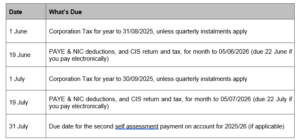
Key tax dates for June and July


Contact us

If you have any queries on the topics discussed in this newsletter, or any other accounting needs, please do not hesitate to email your client manager, or call the office today on:

  • 01284 755956 for Bury St Edmunds Office.
  • 01953 438450 for Wymondham Office.
  • 01473 212717 for Ipswich Office.
  • 01379 641690 for Diss Office.
  • 01449 516506 for Stowmarket Office.

We look forward to speaking with you soon!